
There is a moment in medicine most patients never remember.
It happens after the IV is started. After the consent is signed. After the monitors begin their steady rhythm. The anesthesiologist leans in and says, “Take a few deep breaths.”
The room softens. The lights blur. Voices fade.
And then the patient disappears.
From that moment forward, their life belongs entirely to the people standing over them.
Surgery is one of the most profound acts of trust a human being can make.
This episode explores what happens when that trust is violated — not by disease, not by unavoidable complication — but by repeated, preventable harm.
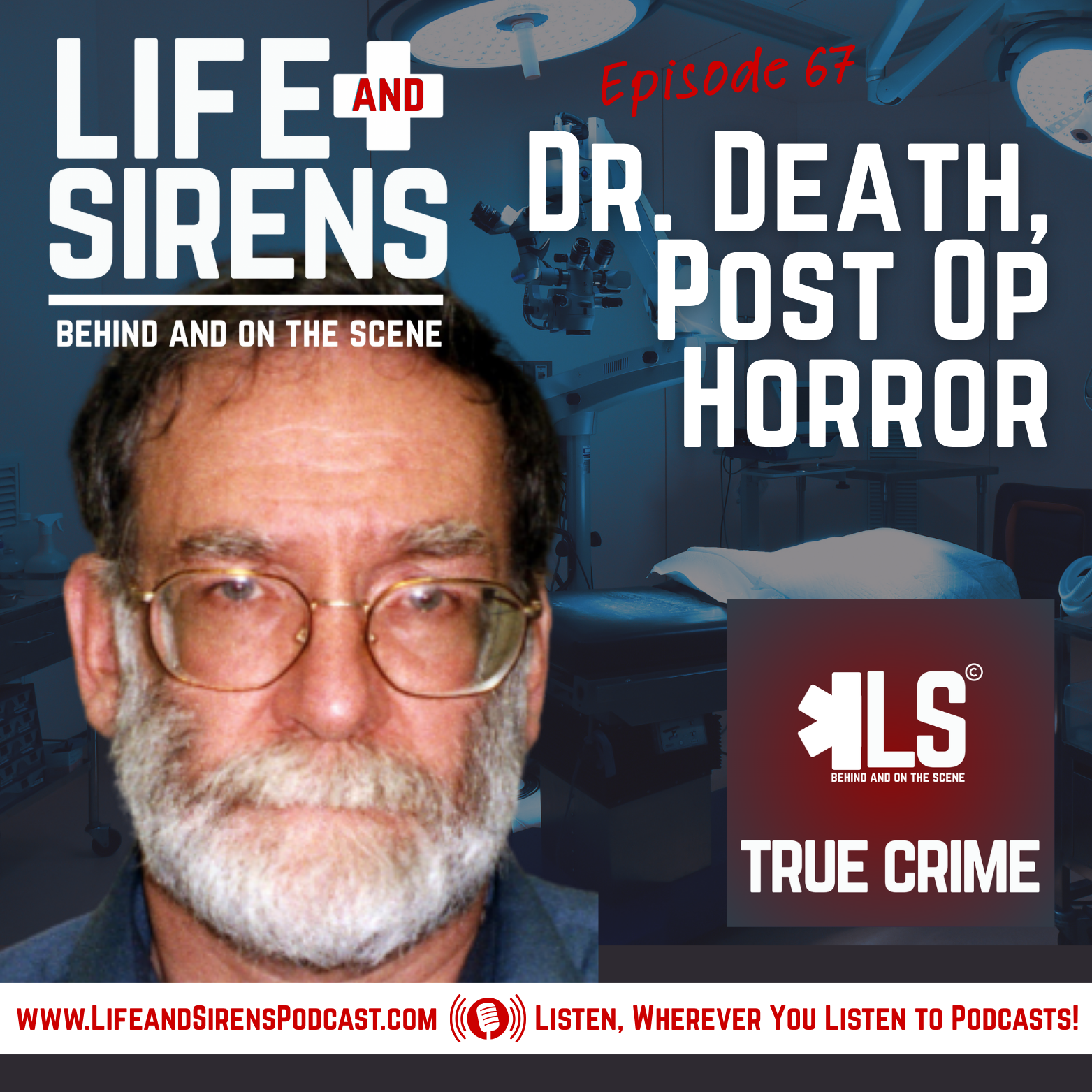
This is the story of Christopher Duntsch, later known as Dr. Death.
But more importantly, this is an EMS story.
Because when healthcare fails — we inherit the fallout.
Why This Episode Matters to EMS
This is not sensational.
This is not entertainment.
Every patient harmed in this case trusted the healthcare system and expected to be made better. Many left permanently injured. Some did not survive.
Those patients did not disappear.
They became:
911 calls
ED patients
Interfacility transfers
Critical care transports
They became someone else’s responsibility.
Sometimes ours.
The Making of a Surgeon — And the Assumption of Safety
Neurosurgery is one of the longest and most demanding training pathways in medicine. Years of medical school. Years of residency. Thousands of hours in operating rooms.
When a surgeon completes that process, an implicit message follows them into practice:
This physician is safe to operate.
Hospitals rely on that assumption.
Patients trust it.
But systems do not fail in dramatic explosions.
They fail in patterns.
When Complications Become Patterns
Every surgeon has complications. Risk is inseparable from intervention.
What defines safe practice is not perfection — it is pattern recognition and accountability.
In Duntsch’s early practice, troubling patterns emerged:
Profound neurological injury after routine spine procedures
Hardware placed inconsistently with safe anatomy
Patients who walked into surgery and could not stand afterward
Corrective surgeries required not for disease — but to repair intraoperative damage
Intraoperative chaos described by staff
A patient death during catastrophic surgical failure
One event demands review.
Repeated events demand action.
But systems sometimes hesitate.
When Institutions Delay
Hospitals operate at the intersection of medicine, law, and finance. Restricting privileges can trigger lawsuits. Reporting can expose liability. Reputations are at stake.
None of that justifies delay.
But it helps explain it.
When physicians quietly resign rather than being formally reported, the danger does not end. It relocates.
By the time Duntsch’s pattern became undeniable, more than 30 patients had been harmed.
In 2017, Christopher Duntsch was convicted of injury to an elderly patient and sentenced to life in prison — one of the rare criminal prosecutions of a physician for conduct inside an operating room.
The verdict carried a message:
Professional status does not place anyone beyond accountability.
The EMS Shift: This Is Where We Enter the Story
It is easy for prehospital providers to distance themselves from hospital failures.
“That’s surgery.”
“That’s not my lane.”
But every breakdown in the system eventually lands in the truck.
How many times have you responded to:
“Recent surgery, now short of breath”
“Post-op patient with fever”
“New weakness”
“Uncontrolled pain”
“Sudden AMS after discharge”
There is a dangerous cognitive trap here:
We assume safety because healthcare was already involved.
But prior care is not proof of current stability.
Sometimes it is the very reason the patient is in danger.
Authority Bias — The Silent Clinical Threat
Authority bias occurs when we unconsciously assume that decisions made by someone higher in the hierarchy must be correct.
“The surgeon discharged them.”
“The hospital evaluated them.”
“They said it was expected.”
Assessment > Assumption.
EMS operates on fresh evaluation.
Your license. Your exam. Your judgment.
You are not obligated to protect someone else’s decision.
You are obligated to protect the patient.
Post-Operative Red Flags EMS Must Never Normalize
Normal recovery does not include rapid deterioration.
Red flags that demand immediate suspicion:
New neurological deficits
Sudden motor weakness
Hypotension
Altered mental status
Respiratory distress
Severe uncontrolled pain
Rapid change after discharge
When something changes quickly — your suspicion should rise quickly.
The Ethics of Standing Up
Healthcare rests on four ethical pillars:
Autonomy — honoring patient choice
Beneficence — acting in the patient’s best interest
Nonmaleficence — do no harm
Justice — fairness and accountability
Ethics are not abstract.
They are operational.
They live in:
Reporting systems
Peer review
Credentialing decisions
Clear documentation
Escalation when something feels wrong
And sometimes…
In the courage to say:
“Something is not right.”
Moral Courage in Real Time
The physicians who ultimately reported Duntsch assumed enormous risk.
Professional risk.
Legal risk.
Social risk.
But silence carries greater cost.
Patient harm.
EMS providers face their own version of this every day:
Challenging dismissive attitudes
Escalating when ED staff minimize concerns
Calling for higher level care
Refusing to downgrade a patient who feels unstable
Advocacy is not personality.
It is professional responsibility.
You Are Part of the Safety Net
The healthcare system is not a building.
It is people.
The nurse who questions.
The physician who reports.
The paramedic who reassesses.
The provider who refuses to ignore a pattern.
Never let hierarchy override your assessment.
Never let reassurance replace evaluation.
Never let discomfort silence clarity.
You are not “just EMS.”
You are a licensed medical professional standing at the front line of patient safety.
Sometimes the difference between harm and rescue is the clinician willing to ask one more question.
IntuBlade
For years, video laryngoscopy has been something most medics couldn't access. The devices cost $15,000. Batteries died mid-shift. Videos got trapped on SD cards. And Medical Directors had no way to see what was actually happening in the field.
IntuBlade changes that.
See the airway clearly.
Secretions, blood, and vomit can obscure your lens during difficult intubations. Our patented lens-clearing technology lets you clear the camera view in real time so you maintain visualization when you need it most.
Prove it. Instantly.
Every intubation records automatically and uploads to secure cloud storage on our free app. Capture an airway confirmation photo if you need it.
Every intubation records automatically and uploads to secure cloud storage on our free app. Capture an airway confirmation photo if you need it.
Generate a secure link. Paste it into your patient record. No SD cards. No file transfers. No gaps.
Know what's working.
Medical Directors get a dashboard that tracks the metrics that matter: First-Pass Success rates, attempts per success, total volume, separated by field calls and training sessions.
See performance across your entire agency. Compare it to national benchmarks. Track it by provider. Watch improvement happen in real time.
This is the data Medical Directors already report to NEMSQA. We just made it automatic.
Always ready.
Battery-free. Connect to the smart device you already have: phone, tablet, whatever's in your rig. If your screen is on, your blade is ready.
What's next.
We're building tools to track pre-oxygenation, generate one-click PDF reports, and integrate directly with ePCR systems like ESO, ImageTrend, and Zoll so crews never have to document twice.
IntuBlade isn't a device. It's a platform that makes better airway management possible for everyone.
Clear the way at IntuBlade.com
