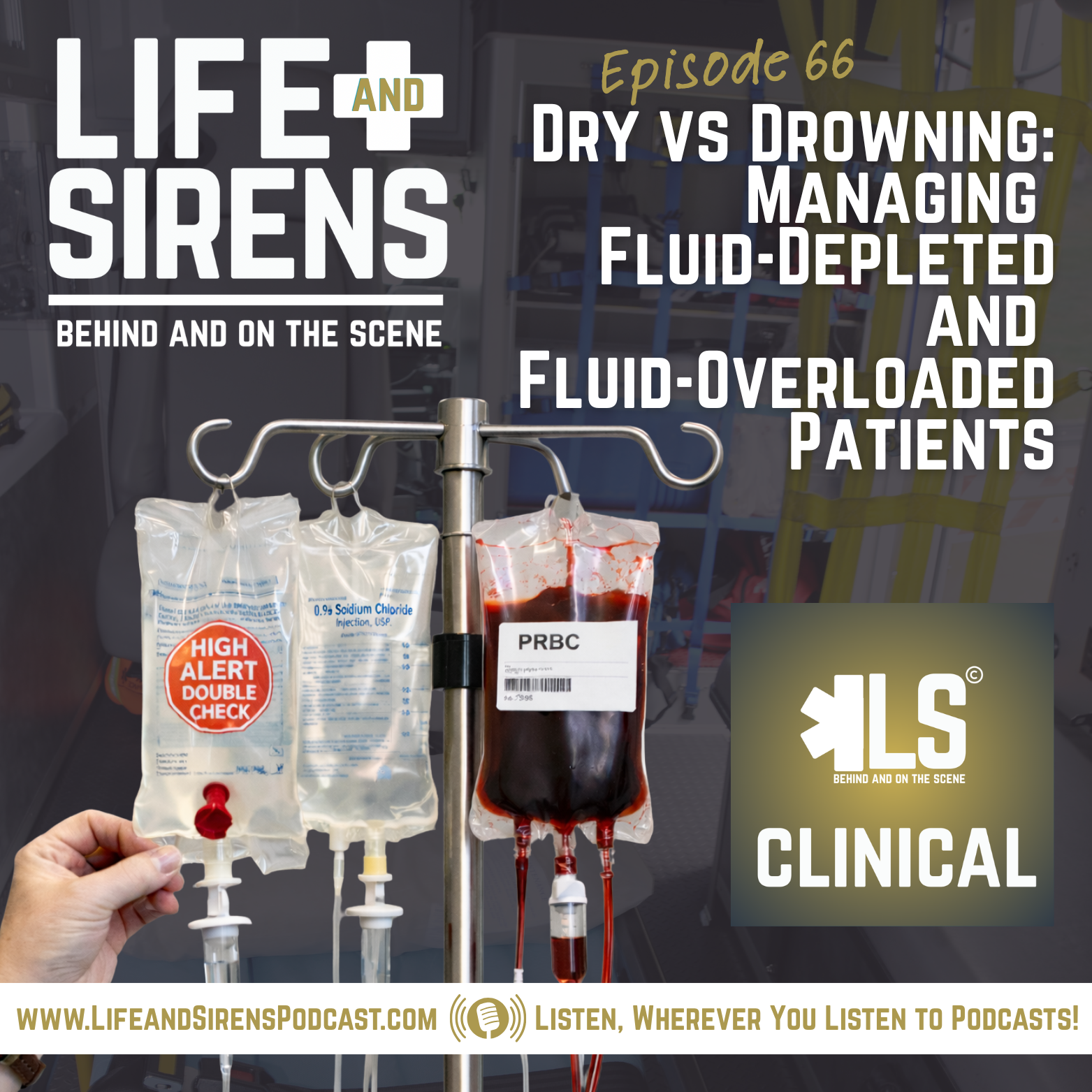
Episode Overview
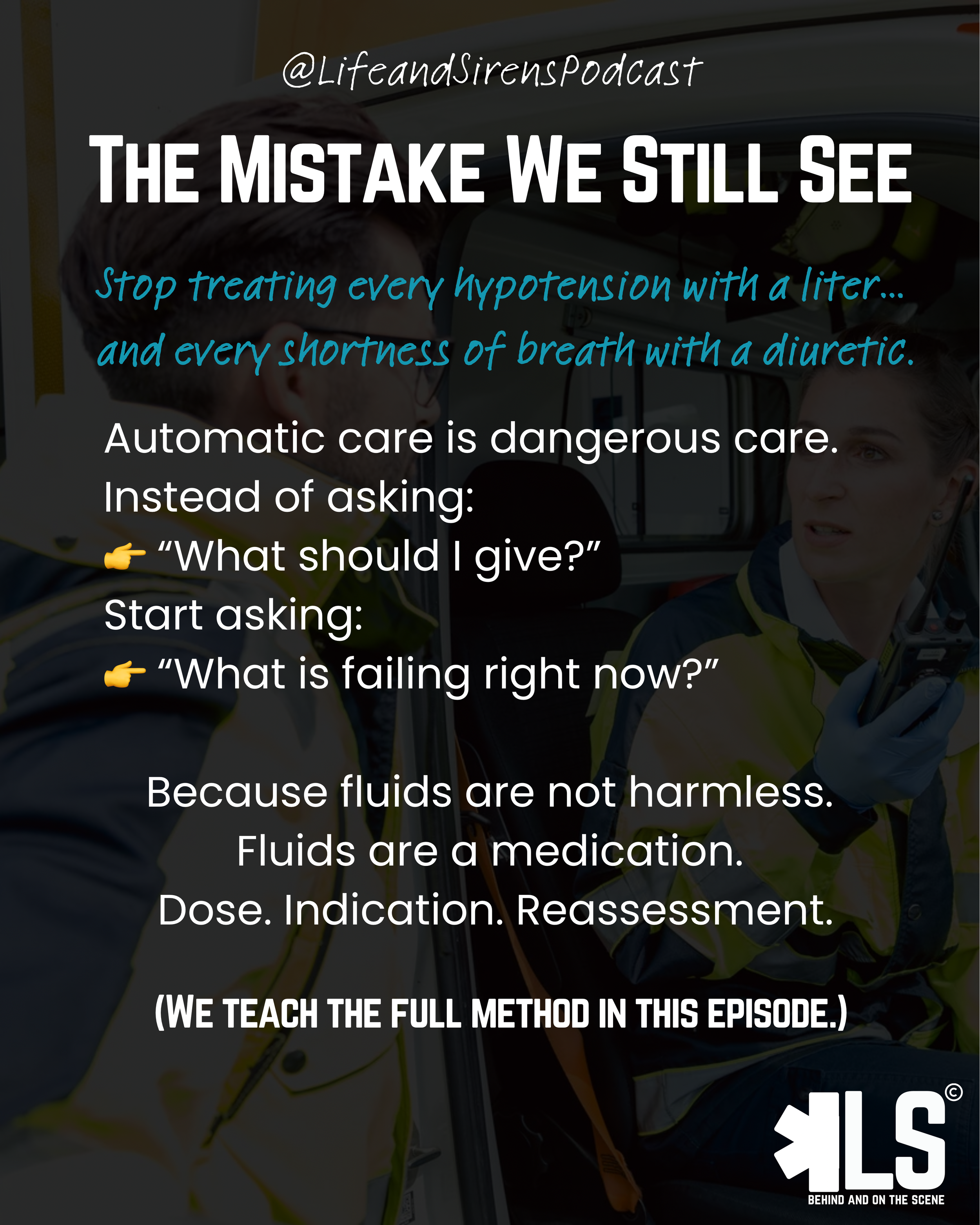
Not every hypotensive patient needs a liter. Not every shortness-of-breath patient needs a diuretic.
In this episode, Sophie, Aubrey, and Jaime walk through one of the most common ways EMS unintentionally worsens patients: reflexive fluid decisions without a structured assessment.
Instead of asking “What do I give?”, this episode teaches you to ask the right questions — in the right order — every single call.
You’ll leave with a repeatable decision-making method grounded in trauma guidance, sepsis recommendations, pulmonary edema research, and real-world EMS constraints.
Because fluids are not benign.
Fluids are a medication — with a dose, an indication, and a reassessment trigger.
What You’ll Learn
✅ A 4-question decision pathway for fluid resuscitation
✅ The 90-second Dry vs. Wet vs. Bleeding exam you can perform anywhere
✅ When crystalloids help — and when they harm
✅ Why CPAP is a hemodynamic intervention, not just oxygen therapy
✅ The danger of the “Lasix reflex”
✅ Modern hemorrhagic shock priorities
✅ How to manage mixed presentations without anchoring bias
✅ Reassessment loops that prevent clinical drift
The Life & Sirens Fluid Method
Stop memorizing treatments. Start recognizing failure patterns.
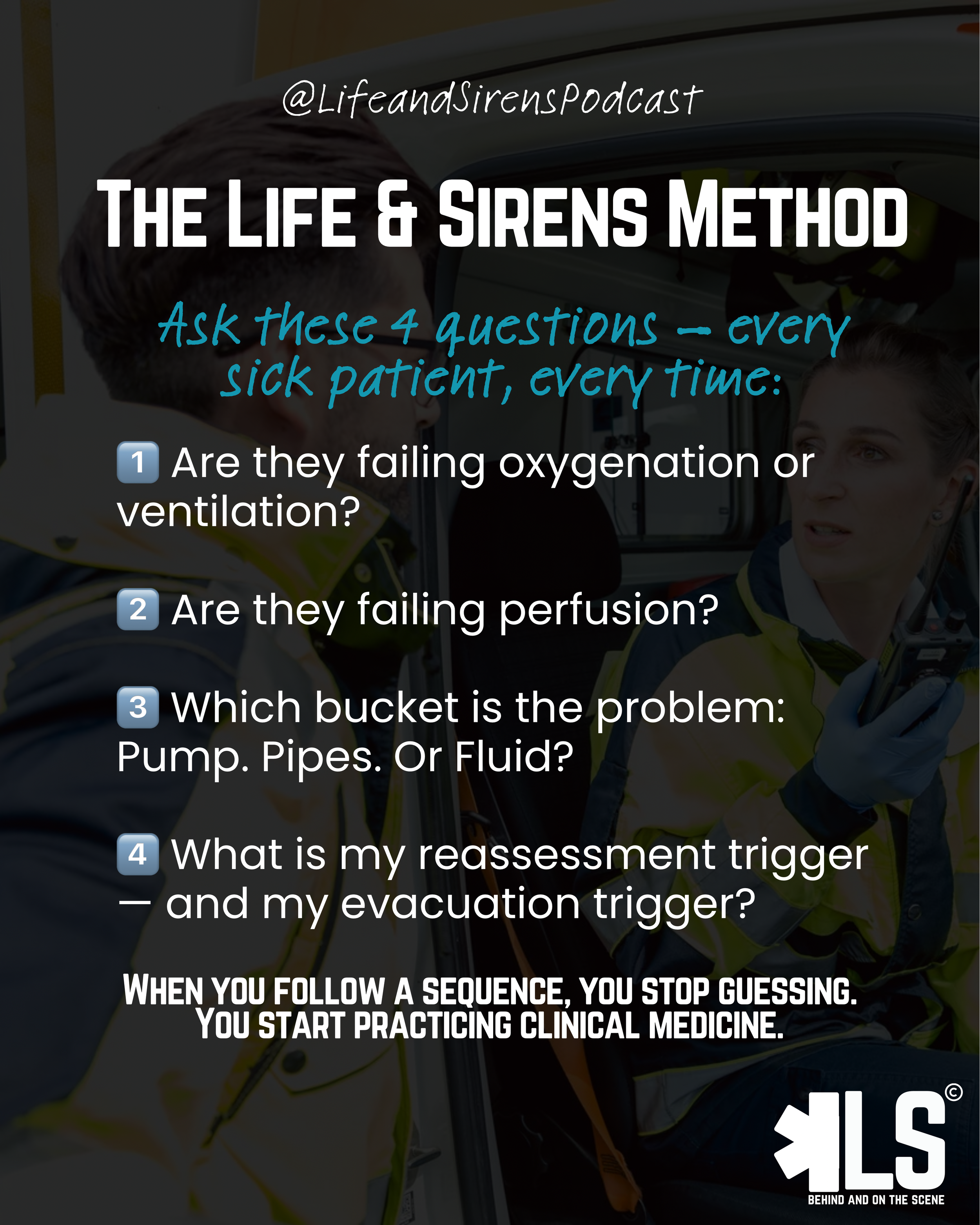
Ask these four questions — in order — on every patient:
1️⃣ Are they failing oxygenation or ventilation right now?
2️⃣ Are they failing perfusion?
3️⃣ Which bucket is the primary failure — Pump, Pipes, or Fluid?
4️⃣ What is my reassessment trigger and evacuation trigger?
Order matters.
A drowning patient needs pressure before volume.
A bleeding patient needs blood before saline.
A septic patient needs fluids — but not blindly.
👉 Perfusion therapy > fluid therapy
The 90-Second Front-End Exam
When scenes are chaotic, simplicity wins.
Look
Work of breathing
Frothy sputum
Skin signs of shock
Visible hemorrhage
Listen
Crackles vs wheezes vs quiet lungs
Story clues: vomiting, dialysis, infection, trauma
Feel
Capillary refill
Peripheral temperature
Pulse quality
JVD (supportive, not definitive)
Numbers That Actually Matter
BP trend > single reading
ETCO₂ as a perfusion marker
SpO₂ + mental status for end-organ function
Once complete, choose your branch:
👉 Dry. Wet. Bleeding. Or Mixed.
The Two Rules That Prevent Bad Calls
Rule #1 — Reassess after every intervention.
Bolus. CPAP. Nitrates. Recheck everything.
Rule #2 — Evacuation is an intervention.
If the fix lives in an OR, ICU, or dialysis center — speed saves lives.
Branch A — DRY (Fluid-Depleted)
Goal: Restore perfusion without tipping into overload.
Common EMS Profiles
GI losses / dehydration
Early septic hypoperfusion
Third spacing (burns, pancreatitis)
Medication-related volume depletion
Fluid Strategy
Isotonic crystalloids remain the default for many non-hemorrhagic shock states.
Start smaller when the diagnosis isn’t clean:
👉 250–500 mL → reassess → repeat if improving
Even obvious dehydration deserves reassessment.
Sepsis Reality Check
The Surviving Sepsis Campaign recommends:
“At least 30 mL/kg of IV crystalloid within the first 3 hours.”
But remember — that is a hospital resuscitation target, not a directive to flood patients in the ambulance.
Early recognition + early communication saves more patients than blind volume.
Pediatric Note
Balanced crystalloids are recommended over normal saline in pediatric septic shock when available.
Evacuation Triggers
Persistent altered mental status
Tachycardia despite fluids
Rising work of breathing
New crackles
⚠️ That last one means your dry patient may be becoming mixed.
Branch B — WET (Fluid Overload / Pulmonary Edema)
These patients don’t need volume.
They need pressure, afterload reduction, and destination decisions.
Common Profiles
Acute cardiogenic pulmonary edema (including SCAPE)
ESRD / missed dialysis
CHF exacerbations
Iatrogenic overload
Your Highest-Yield Tool: CPAP
A major JAMA meta-analysis found:
“Noninvasive ventilation reduces the need for intubation and mortality” in acute cardiogenic pulmonary edema.
Start CPAP Early When:
Moderate or severe distress
Hypoxia
Crackles
Fatigue
Reassess within 2–3 minutes.
Nitrates
When blood pressure supports it and protocols allow:
Nitrates + CPAP is one of the most powerful combinations in prehospital medicine.
Use caution in borderline pressures.
The Lasix Reflex — Slow Down
NAEMSP commentary highlights diagnostic complexity in pulmonary edema and emphasizes nitroglycerin-focused care.
EMS diagnostic accuracy for acute heart failure can be inconsistent — making reflex diuretic use risky.
👉 Treat the physiology.
👉 Not the assumption.
Evacuation Triggers
CPAP failure
Worsening fatigue
Rising ETCO₂ with somnolence
Dialysis-dependent pulmonary edema
These patients often need definitive hospital therapies quickly.
Branch C — BLEEDING (Hemorrhagic Shock)
Stop asking how much saline they need.
Start asking how fast you can restore oxygen-carrying capacity.
Modern Trauma Direction
Avoid large-volume crystalloids
Permissive hypotension may be appropriate without TBI
Correct hypotension aggressively when TBI is present
Blood in EMS Is No Longer Rare
As of 2023:
👉 120+ U.S. EMS systems carry blood products
👉 Most utilize low-titer O-positive whole blood
The Prehospital Blood Transfusion Coalition released a civilian EMS guideline in 2025 — signaling a major shift in prehospital trauma care.
If You Carry Blood
Transfuse early when criteria are met
Prevent hypothermia
Consider calcium per protocol
If You Don’t
Remember:
👉 Hemorrhage control IS your fluid.
Control bleeding
Limit crystalloids
Transport rapidly
Do not chase normal blood pressure in uncontrolled hemorrhage.
The Mixed Patient — Where Providers Get Hurt
Sepsis may begin dry and end wet.
Burn patients can be empty intravascularly but swollen everywhere else.
The solution is not guessing.
It’s movement.
The 2–3 Minute Loop
Intervene → reassess → decide:
Repeat
Switch branches
Evacuate faster
Never marry your first impression.
Clinical Takeaways
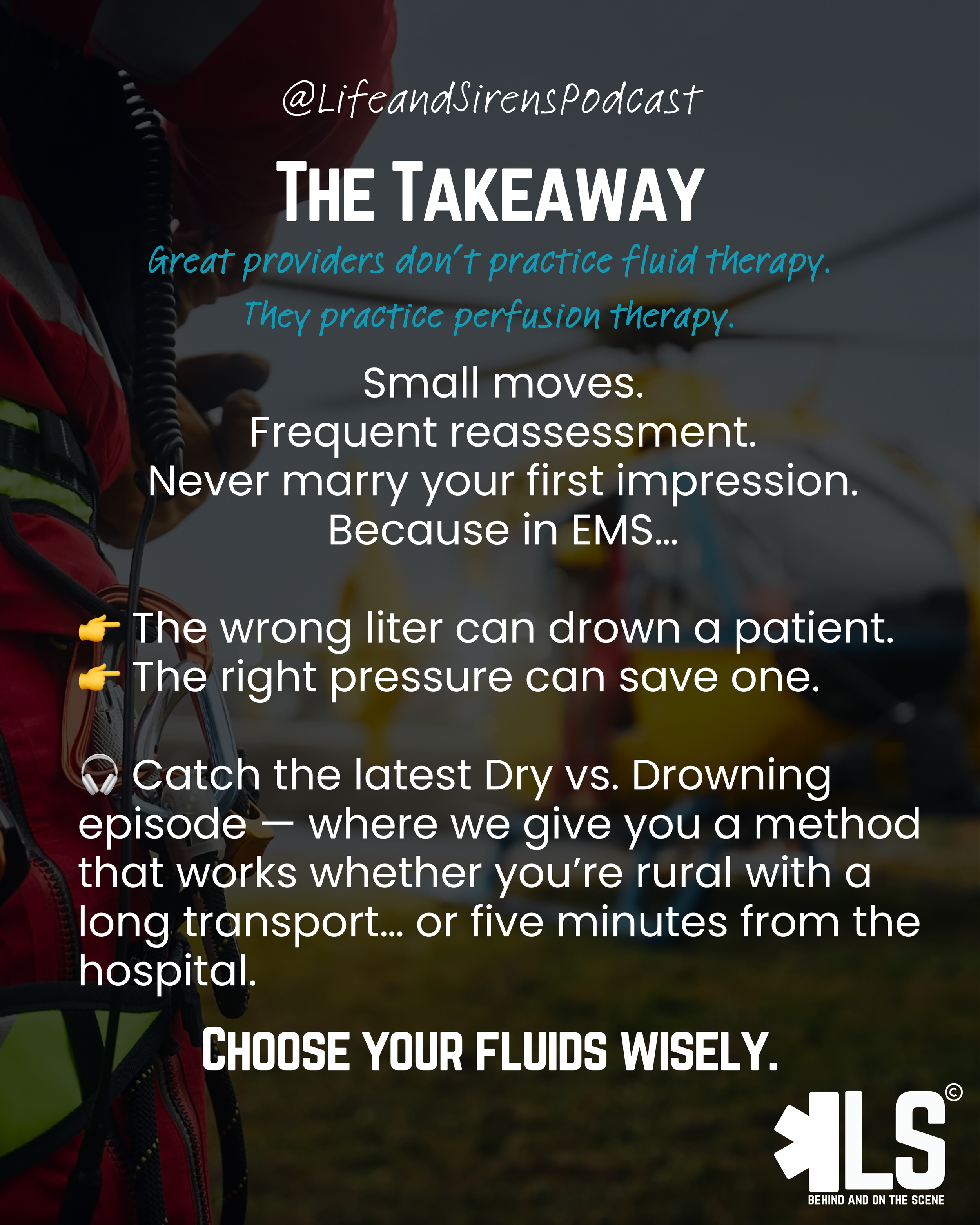
⭐ Practice perfusion therapy, not fluid therapy
⭐ CPAP is a hemodynamic intervention
⭐ Blood and speed beat saline in hemorrhage
⭐ Small moves + frequent reassessment prevent iatrogenic harm
Listen If You Want To Become the Provider Who:
Treats physiology instead of habits
Avoids reflex medicine
Recognizes shock earlier
Makes cleaner transport decisions
Practices high-level reassessment
Call to Action
If this episode brought you value, take a moment to rate and review the show — it helps more providers find us.
Follow Life & Sirens, join our mailing list for exclusive education, and visit LifeAndSirensPodcast.com for resources and downloadables built for the modern provider.
And if this conversation made you think — send it to your partner, your preceptee, or someone on your crew.
Because better providers build better systems.